11 members and friends of the CGS travelled by ferry to stay at Melrose House, Douglas where we were given an introductory evening talk on the general geology of the island in its Plate Tectonic context by our leader for the week, Dr. Steve Crowley of Liverpool University and each issued with a detailed booklet of the locations to be visited in the next three days. isle of man
Tuesday 12 July The main theme of the day was the events of the Lower Palaeozoic including the Lower Ordovician Manx Group submarine fan deposits exposed in locations around the south coast, late Caledonian deformation and regional low-grade metamorphism, Foxdale Granite magmatism and contact metamorphism and base metal mineralization.
Wednesday 13 July This day dealt with basic magmatism, the contact zone between Manx Group and mid-Silurian Dalby Group turbidite meta-sediments, mid-Silurian sedimentology, late Caledonian deformation and regional low-grade metamorphism, and Lower Devonian fluvial sediments of the Pele Group.
Thursday 14 July Our main focus on this final day was the sedimentology and volcanology of the Lower Carboniferous carbonate-dominated succession exposed around the south coast in the Castletown area.
Apart from two short but intense showers on Wedneday afternoon we enjoyed good weather and visibility. We are indebted to Fiona Harwood for driving us around in the hired mini-bus, to Susan Beale for organising the visit and especially to Steve Crowley who constantly kept us informed and stimulated throughout a concentrated three-day period.
A new geology panel is unveiled at Birkhams Quarry
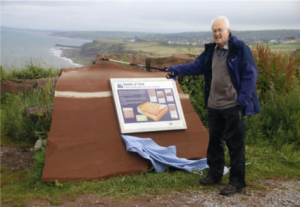
On 11 July 2016 Mervyn Dodd unveiled two interpretation boards at Birkhams Quarry on St Bees Head. Mervyn, a founder member of Cumbria GeoConservation (CGC, then known as Cumbria RIGS) designated Birkhams Quarry as a RIGS site in 1997 (LGS 4/030) for its ‘fresh cross sections through fluvial sandstones which show sedimentary structures clearly’.
As befits a geologist, Mervyn first set the scene by walking the group to the north to give a view of the Barrowmouth unconformity. A change from purple to a buff colour on the wave cut platform far below shows the eroded surface of the Upper Carboniferous Whitehaven Sandstone, above which lies the Permian Brockram and Magnesian Limestone and shales and the overlying Triassic St Bees Sandstone which forms the present headland and cliffs.
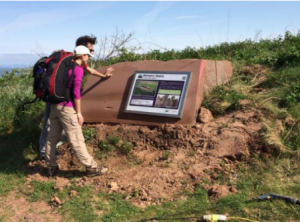
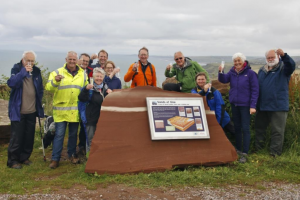
The boards are the result of detailed collaboration, between CGC, Cumbria County Council planners, the quarry company Marshall Stancliffe and their agents Stephenson Halliday of Kendal who prepared the many documents for the planning application. Planning approval has now been given to extend the quarry back into the headland. The geological interpretation, text and block diagram, for the geology board was the work of Elizabeth Pickett and was designed by graphic designer Marcus Byron in line with the design brief of the National Trust’s Colourful Coast. Most of these people attended the formal unveiling at the quarry, as cloths were whisked off, champagne glasses were raised and rock cakes (what else?) were consumed, to the general interest of the many Coast to Coast walkers that morning.
The geology board shows an interpretation of the area 250 million years ago when the sandstone was laid down, and the quarry board explains the quarrying processes and products. Each board is placed on a cut face of a large sandstone block, chosen by CGC members and taken to Locharbriggs quarry near Dumfries to be cut and shaped. The blocks themselves show excellent examples of current bedding, ripple marks, mud clasts, reduced layers and small channels. A visit is strongly recommended.
In photograph: Mervyn Dodd (founder member of Cumbria RIGS, now Cumbria GeoConservation); Steve Boam (Quarry Manager, Birkham’s Quarry), Marcus Byron (Designer), Sylvia Woodhead (Geological Coordinator, Cumbria GeoConservation), David Forsyth (Landscape Architect, Stephenson Halliday), Elizabeth Pickett (Geological illustrator), Peter Woodhead (Chair, Conservation Group, Cumbria Wildlife Trust), Clive Boulter (Cumbria GeoConservation), Julie Harrald (Director, Geology Trusts and member of English Geodiversity Forum), Audrey Brown (Chair, Cumbria GeoConservation) and Chris Brown (Cumbria GeoConservation).
Photographer – Chris Thompson (Treasurer, Cumbria GeoConservation).
At the end of a wet day, ten members gathered on Beacon Hill, Penrith on a surprisingly fine evening. John Rodgers set the scene by describing the landscape features to the west of Penrith, well seen from this vantage point. The party then proceeded to Cowraik Quarry where Fi Harwood drew attention to the drumlinoid topography in the immediate foreground. The cover for the drilling for water supplies in the 1976 drought was noted and local water supply and sources discussed. Fi then led us up to the first exposure of Penrith Sandstone, and here a deep red very poorly cemented rock. The hematite coated grains were the well rounded and the rock very friable. We then proceeded to the first of two major faces in the disused quarry. The first displayed large scale cross-bedding, typical of barchan sand dunes, though it was difficult to determine just how many dunes could be identified. John Rodgers had nobly carried a bag of sand and treated the party to a practical demonstration of the formation of the dunes. Fi drew our attention to the approximately horizontal mineralized striations on two vertical faces. Considerable discussion ensued as to whether these were the slickensides and precisely how they were formed.
At the second major quarry face the sandstone was more blocky. Graded bedding could be identified within the dunes. More ‘slickensides’ were observed and more discussion, particularly on the formation of the mineralization along these surfaces ensued. The grains from this quarry were particularly well rounded “millet seed” quartz. Discussions of provenance of the grain, deemed to come from the south, and the processes of cementation concluded the evening before the party returned to the cars and thanked Fi and John for a most interesting evening.