

OUGS NW Registration
OUGS NW Event
Tipping positive change to avoid climate tipping points
Wednesday 7th February 2024.
At 19.30
Meeting opens 10 minutes before.
Zoom link available to members
Prof. Tim Lenton, Exeter University.
Tipping points in climate science normally refer to small changes in the Earth system that unleash much broader, typically damaging impacts that accelerate climate change. Well-known examples are rising sea levels due to disintegration of the Greenland and West Antarctic ice sheets, or the release of methane from the thawing permafrost. They help to underline the urgency of climate action. Today most people understand we must reduce emissions – and very quickly.
This evening Tim will summarise recent evidence regarding climate tipping points, which supports declarations that we are in a ‘climate emergency’. Then he will turn to identifying positive social tipping points that will need to be triggered to have any hope of limiting global warming to well below 2C.
Tim Lenton is Chair in Climate Change and Earth System Science at Exeter University. His 25 years of research includes developing models to understand the Earth’s behaviour. He co-authored the “Planetary Boundaries” framework and is renowned for his work identifying climate tipping points. He won the European Geosciences Union Outstanding Young Scientist Award in
2006 and subsequently many other prestigious awards. He is in the top 100 Reuters “Hot List” of the worlds top climate scientists so is good at communicating his extensive knowledge.

Social Meeting 2024
Ballantrea Weekend Excursion & Summer Events Outline
Some members have expressed interest in a weekend trip, so the following has been arranged:
All day Saturday 29 June 2024 and half-day Sunday 30 June 2024
The Girvan-Ballantrea Complex: Ayrshire coast
Excursion leader: Conn Gillen (University of Edinburgh)
Geology
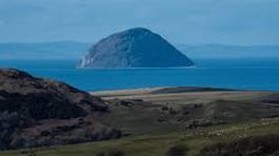
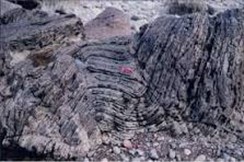
This will be an opportunity to examine and discuss an ophiolite complex – diverse Ordovician age rocks from the mantle and ocean crust, juxtaposed by faulting. Ophiolites are quite rare. Other ophiolites are in Cornwall and Shetland, so the Girvan-Ballantrae area is definitely our nearest! I expect we’ll examine Silurian strata as well. The origins and histories of these rocks are complicated, but our leader, Conn, is familiar with guiding various groups here and has also offered a pre-trip Zoom briefing. Attendees can get involved with the geological intricacies or take a more introductory approach and admire the excellently exposed rocks that we’ll see, such as pillow lavas, layered chert and so-on.
Background information can be found online. There’s an introduction at: https://www.geologynorth.uk/ballantrae-ophiolite-complex/ More detailed references with geological information will follow with confirmation of your booking.
Practicalities
Attendees need to be ready to start on the Saturday and Sunday mornings. Given the distance from Cumbria this means that arrangements need to be made for Friday night and Saturday night accommodation. (Dates and timing have been governed by low tide conditions). Attendees might want to share transport and accommodation and will need to make their own arrangements. Details of some accommodation suggestions will follow on confirmation of booking. The aim is to have about 15 attendees with individual costs of £20 to cover any possible CGS outlays.
A moderate amount of coastal / foreshore walking will be involved. Stout footwear and weather gear will be needed, as for most of our field excursions. Conn will provide more guidance on topics such as fitness, walking distances, parking / meeting spots, loo stops, potential lunch stops, etc in due course. Attendees will need to use their own vehicles (hopefully shared) to get to start points.
At present there’s no fixed plan for meeting up socially on the Friday or Saturday evenings – this might be fun and is something that can be considered nearer the time (or on the spot).
The excursion is expected to end around lunchtime on Sunday 30 June. Attendees may wish to use the afternoon for more exploration of the Ayrshire coast (seal spotting?!) or for their return trip, or they could extend their stay of course.
Booking details
In view of the need to book up accommodation soon, if you are interested in the trip please add your email address via the form together with payment of £20 to CGS trip account with ref BALLAN Name; Sort code 20 18 47 ; Account No. 90207128 by 2 February 2024. Bookings will be on a first come first served basis. Should the trip not be viable deposits will obviously be returned.
Any non-members who wish to attend, please join the society prior to registering.
Form to Book a Place
Phil Davies, CGS President